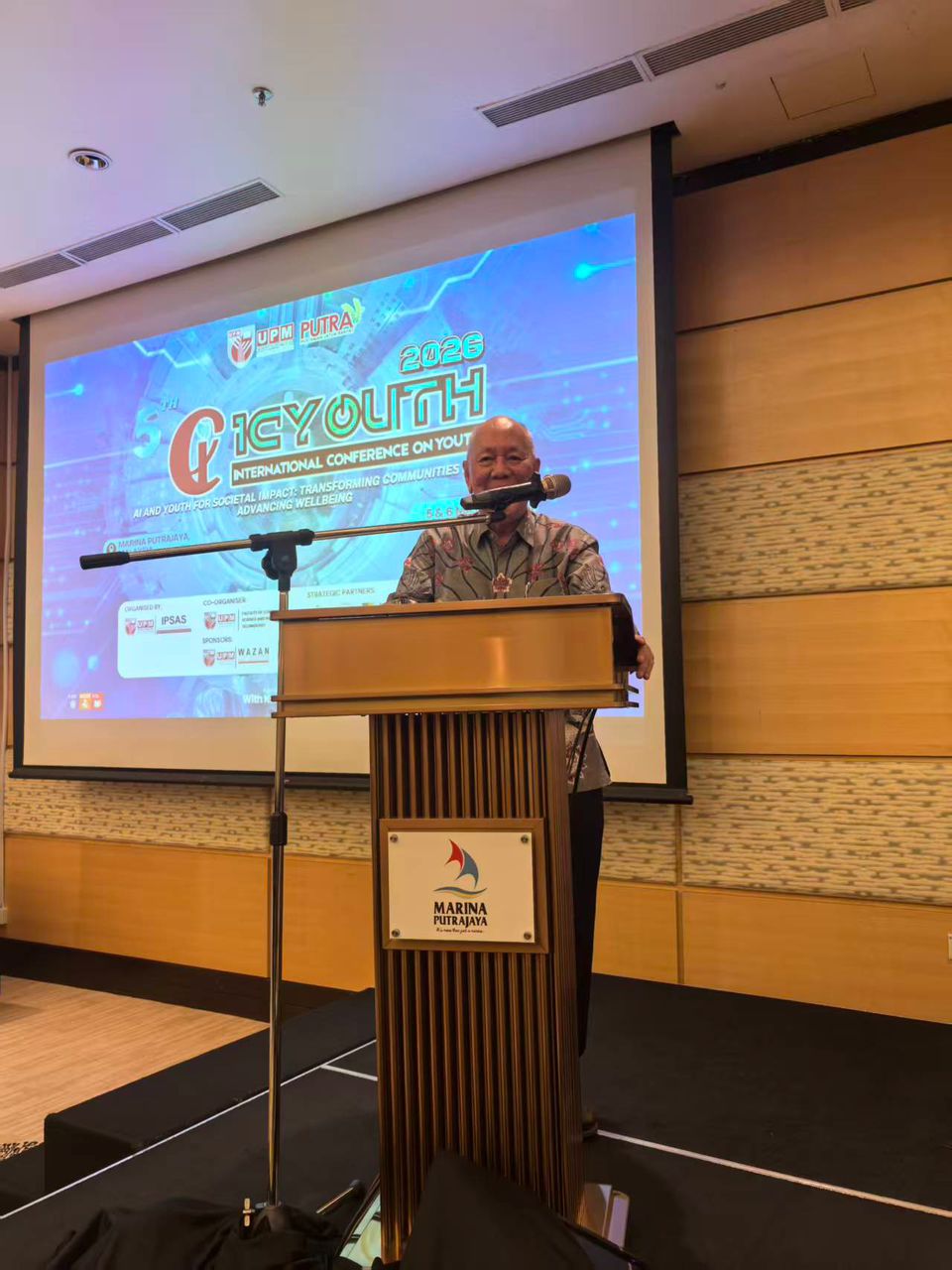
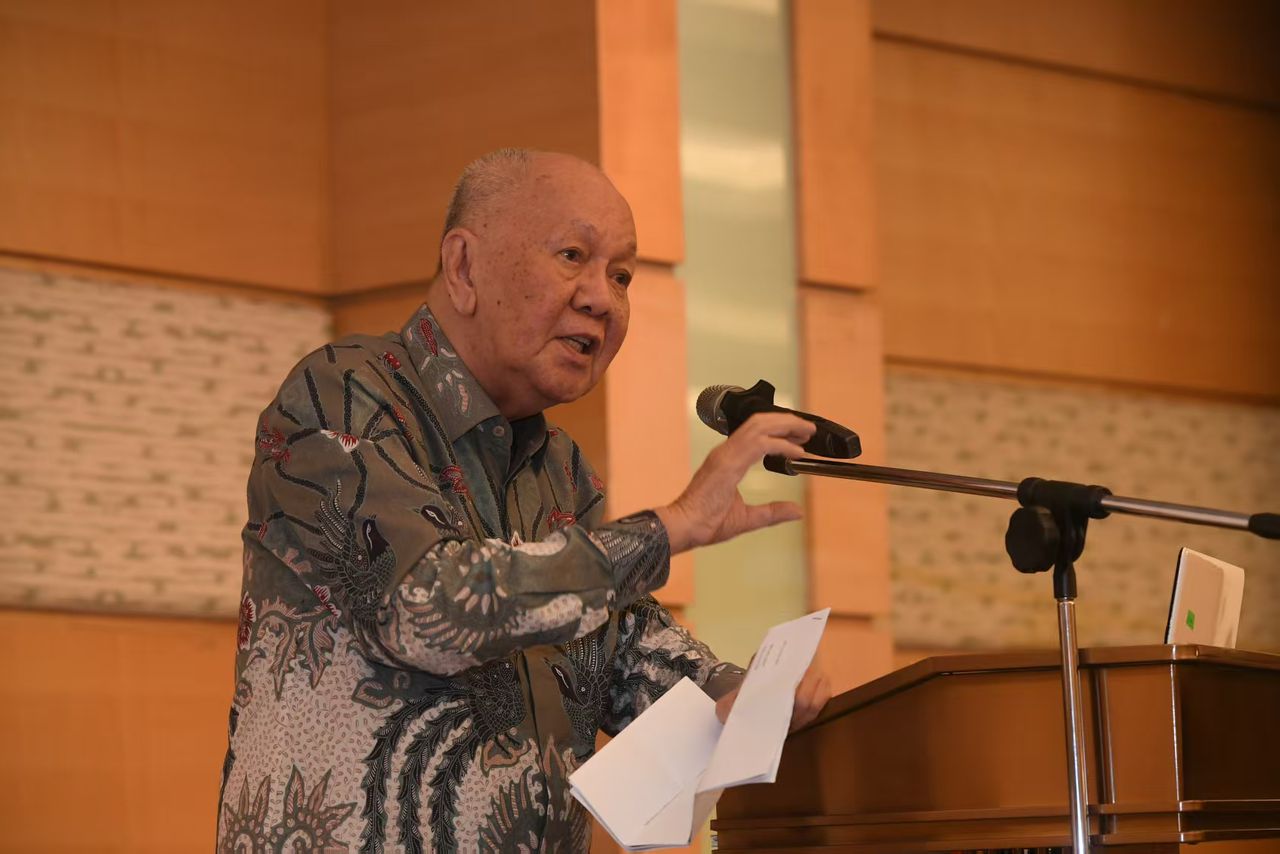
Academician Dato Ir. (Dr) Lee Yee Cheong was invited as a panelist at the International Conference on Youth (ICYouth) 2026 organised by the University Putra Malaysia (UPM), themed “AI and Youth for Societal Impact” 5-6 May 2026 in Marina Hotel Putrajaya, Malaysia.
Below is his contribution:
I am very honoured to represent ISTIC in the panel on “Hope or Hype? Finding the Sweet Spot between AI Buzz and Real Impact. ISTIC is the UNESCO International Science, Technology and Innovation Centre for South-South Cooperation, hosted by the Government of Malaysia in Kuala Lumpur. It is the only UNESCO Centre dedicated to South-South Cooperation. I was the Chairman of ISTIC governing board when ISTIC was established in 2008, and am still the Honorary Chairman.
One of the priority programs of ISTIC was Inquiry-Based Science Education IBSE which is the “Learning By Doing” pedagogy to wean schoolchildren away from book and rote learning in STEM subjects. IBSE was pioneered by the La Main a la Pate (LAMAP) Foundation of the French Academy of Sciences. ISTIC’s local partners were the Institute of Teacher Training of the Ministry of Education Malaysia and the Regional Education Centre for Science and Mathematics (RECSAM) of the South East Asia Ministers of Education Organisation (SEAMEO). Many training workshops were conducted for school teachers in Malaysia and other ASEAN countries with LAMAP trainers from France. Then COVID-19 put a stop to cooperation with LAMAP.
Meanwhile, the centre of gravity for STEM education has shifted to Asia, with China putting Artificial Intelligence AI in the core of STEM education. While ISTIC Chairman, I proposed the Academy of Engineering and Technology of the Developing World (AETDEW) to help developing countries achieve the UN Sustainable Development Goals by 2030. AETDEW was established in Malaysia in 2017. I am AETDEW founding president. AETDEW attracted many eminent Chinese STI practitioners as Fellows. The ISTIC IBSE training program has now become the AETDEW AI Education program.
There is without doubt that AI is the engine for employment and wealth creation in the world. It is also the agent of disruptive unemployment and wealth dissipation. China is the nation where AI anchors every aspect of life. AI has enabled China to become the 2nd biggest economy in the world. China is on course to become number one. Many in the West have credited the spectacular rise of China to AI education from kindergarten through primary, secondary, and tertiary education, to lifelong AI training in industry over the past two decades. I attended an AI conference in Beijing in 2018 and participated in an AI teacher training workshop. I was amazed at the AI school textbooks available. Here are some examples of AI textbooks for primary schools. Here is the secondary school AI textbook, authored by AETDEW Fellow Professor Han Liqun in 2019. Here is the “Guide for Primary and Secondary School AI Curriculum” by Professor Han Liqun and AETDEW Fellow Dr. Shi Yan. All the above publications are in Chinese. I have requested Professor Han Liqun to translate them into English for distribution by AETDEW to the Global South. She is seeking the permission of the publishers. The Guide in Chinese is available in digital form. I have sent it to the conference organizer to make it available to you.
With Professor Han Liqun, Dr Shi Yan, and other AETDEW Fellows in China who are AI education practitioners, AETDEW has established the Consortion of AI Education for the Global South for developing countries to learn from China’s experience in AI education. The Consortium has its Malaysian office at Sri Bisteri Private School Kuala Lumpur, and its China office at Sichuan University, Chengdu. The Consortium started with AI Literacy Training Workshop for ASEAN STEM teachers in Sri Bisteri Private School in Kuala Lumpur in 2025 with four Chinese trainers, namely Professor Han Liqun, Dr Shi Yan, AETDEW Fellow Professor Zhao Shuying and AETDEW Fellow, Zhang Yibao. The workshop established the Malaysia-China AI Teacher Exchange Program. On 28-29 May 2026, a top AI-teacher training workshop will be held in Chengdu, organized by the Chengdu Education Society. The training objectives are (i) Enhance AI Literacy, (ii) Strengthen Teaching Competence and (iii) Promote Deep Integration. AETDEW has been able to obtain five places for Malaysian teachers with myself, funding their airfare and Chengdu organizer, funding all their expenses in Chengdu. Through Consortium members in Malaysia, AETDEW received many applicants who are competent in Mandarin, as the workshop will be conducted in Mandarin. I am very pleased that the five include three ethnic Chinese teachers and two Malay teachers. They are from Kuala Lumpur, Ipoh, Jitra, Kedah, Kuala Terengganu and Sibu, Sarawak. They comprise three ladies and two men. The Training Workshop will be repeated in English in Kuala Lumpur in the autumn of 2026 with Chinese trainers and teachers from the Chengdu workshop. Hopefully, some of the five Malaysian teachers will also become trainers in the Kuala Lumpur workshop.
You may well ask that with AI education so comprehensive and established in China for the past two decades, why does China still need to train top AI teachers as trainers. I believe that, due to the rapid rise of AI in education in China, there is fear among Chinese teachers that they will be made redundant by robots. They need reassurance that robots are teaching aids to help teachers improve their teaching. They will not replace teachers. In my opinion, robots can replace teachers in STEM subjects. Human beings are superior in culture, civilization, religious and spiritual values, literature, poetry, music, and painting, etc. That is why, in China increasing emphasis is placed on civilization, culture, history, and literature in the school curriculum.
In 2027, AETDEW hopes to hold the AI literacy training workshops with Chinese and Malaysian trainers in Africa.
As for university education, China has been requesting major enterprises to assist with tertiary education. An example is the Xiaomi-led China Industry-Education Integration Community. AETDEW signed an MOU with the Community during the launch of the Community in Guiyang in 2024. The Community has 3 projects in the first five years. The first project is to build AI and digital technology training centres in member universities in China. The second project is the attachment of member university lecturers and students in Xiaomi enterprises. The third is to build ten AI and digital training centres in developing countries, starting with Malaysia in UTAR, and Indonesia.
During the Q and A discussion, there was consensus that AI will improve the learning capacity and capability of university students. I put forward the question: “Will universities still be needed?” I cited the decline in enrolment of engineering courses in Malaysian universities. With AI, is it still necessary to maintain a four-year engineering course that parents find too expensive and students find too long? Why not reduce the duration of engineering course to two years and make universities still relevant in the AI era.
,